X-Block Safety Data Sheet
Safety, handling, storage, and disposal information for X-Block.
X-Block Safety Data Sheet (PDF)

BIO-BLOCKS®
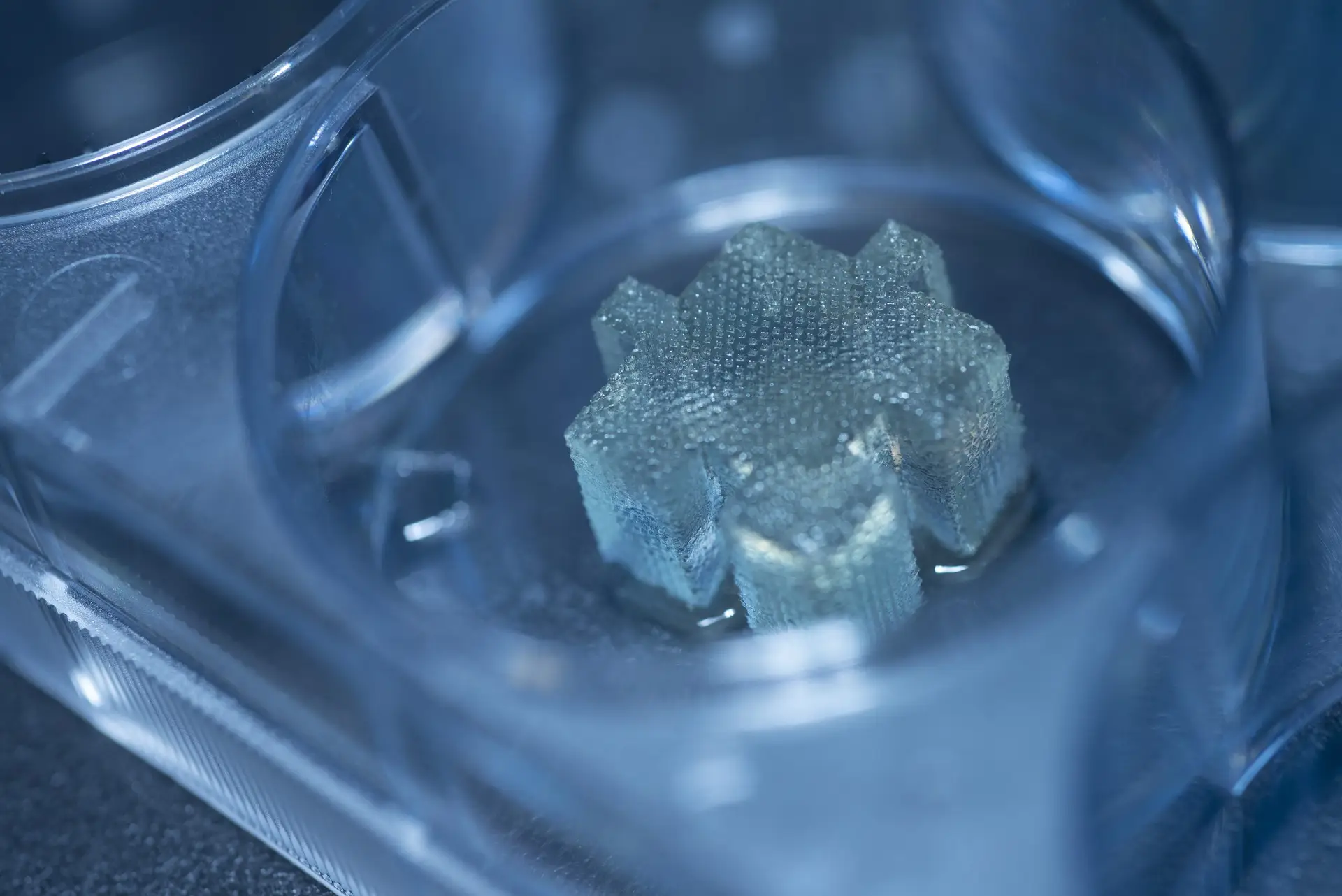
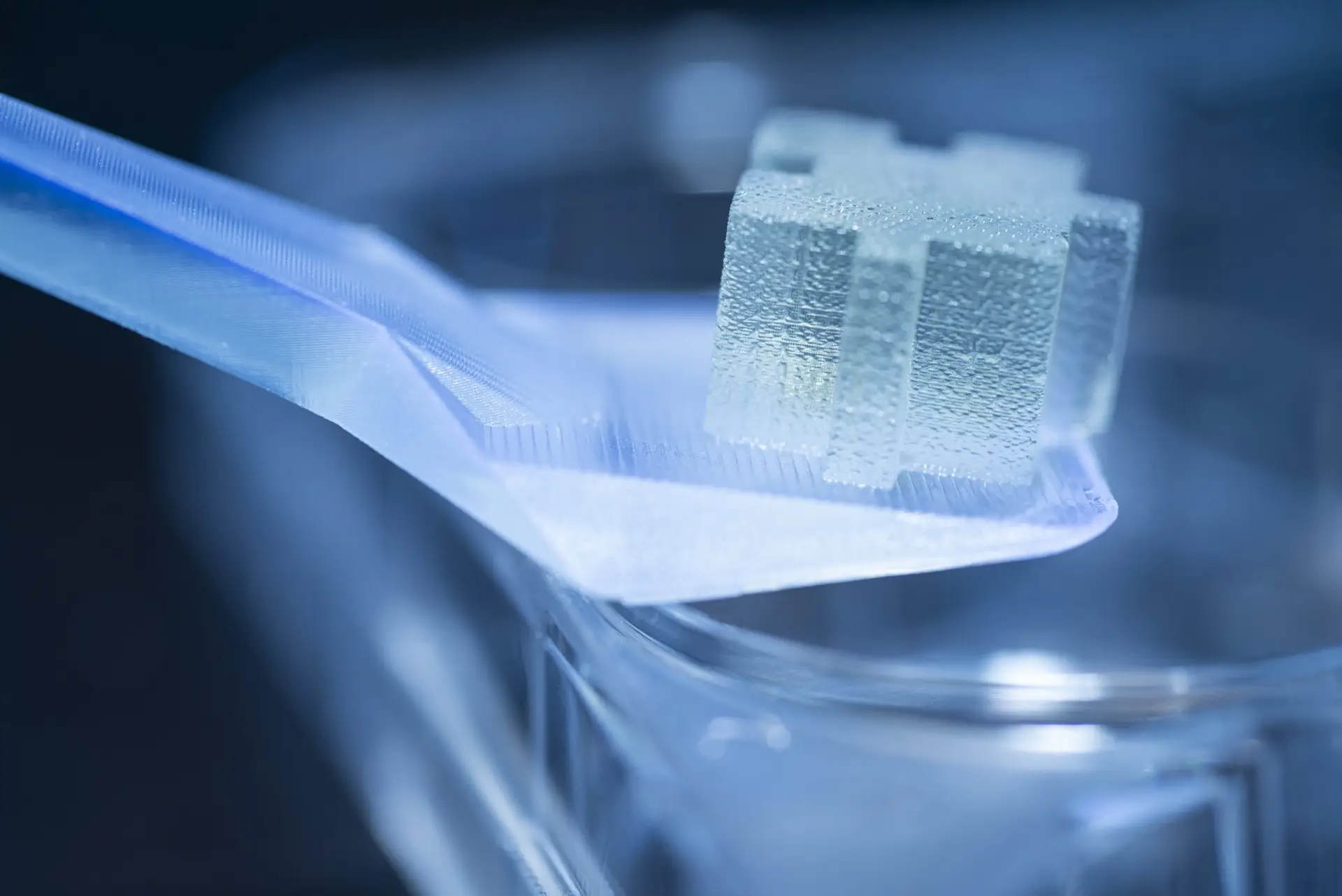
You have a biological question worth pursuing. Build a 3D culture environment around it with X-Block™, a modular hydrogel culture unit supplied without cells. You choose the cells, media, and analytical methods appropriate for your experiment.
300 µm
Microchannels
Acellular
Supplied without cells
4 °C
Recommended storage
Aseptically
Manufactured
APPLICATIONS
Start with the question that matters to your lab. Configure Bio-Blocks® to explore cellular interactions, responses to injury and stress, or the outputs of a 3D culture environment.
Bring your questions about cellular interactions into 3D. Organize cells within configurable culture environments to investigate how different cell populations behave together.
Useful for adherent-cell systems, multicellular models, and tissue-oriented research workflows.
Follow the cellular responses you want to understand. Apply defined experimental challenges and investigate how cells respond within a three-dimensional environment.
Explore changes in cell state, morphology, signaling, viability, recovery, and related biological readouts.
Collect and analyze cells, conditioned media, secreted factors, extracellular vesicles, and other experimentally relevant outputs generated under different culture conditions.
Explore what your culture conditions may reveal about what cells produce and how those outputs change.
DIFFERENTIATION
Your research question should guide your culture design. Bio-Blocks® combine modular architecture with practical workflows so you can choose how to assemble, culture, and analyze your biological environment.
Choose the cell populations and experimental conditions that serve your study. Configure Bio-Blocks® around the biological question you want to investigate.
Keep your intended analysis in view from the start. Bio-Blocks® support 3D culture, biological response studies, imaging, conditioned-media collection, fixation, histology or immunolabeling, and cell recovery with X-Tract™.
Start with methods Ronawk has developed for cell seeding, plate and tube culture, imaging, fixation, cell recovery, and downstream analysis. Use these as a foundation for the optimization your cell model and experiment require.
Demonstrated across a broad range of primary cells, established cell lines, and tissue explants, with especially extensive experience in adherent-cell and MSC culture.
WORKFLOW
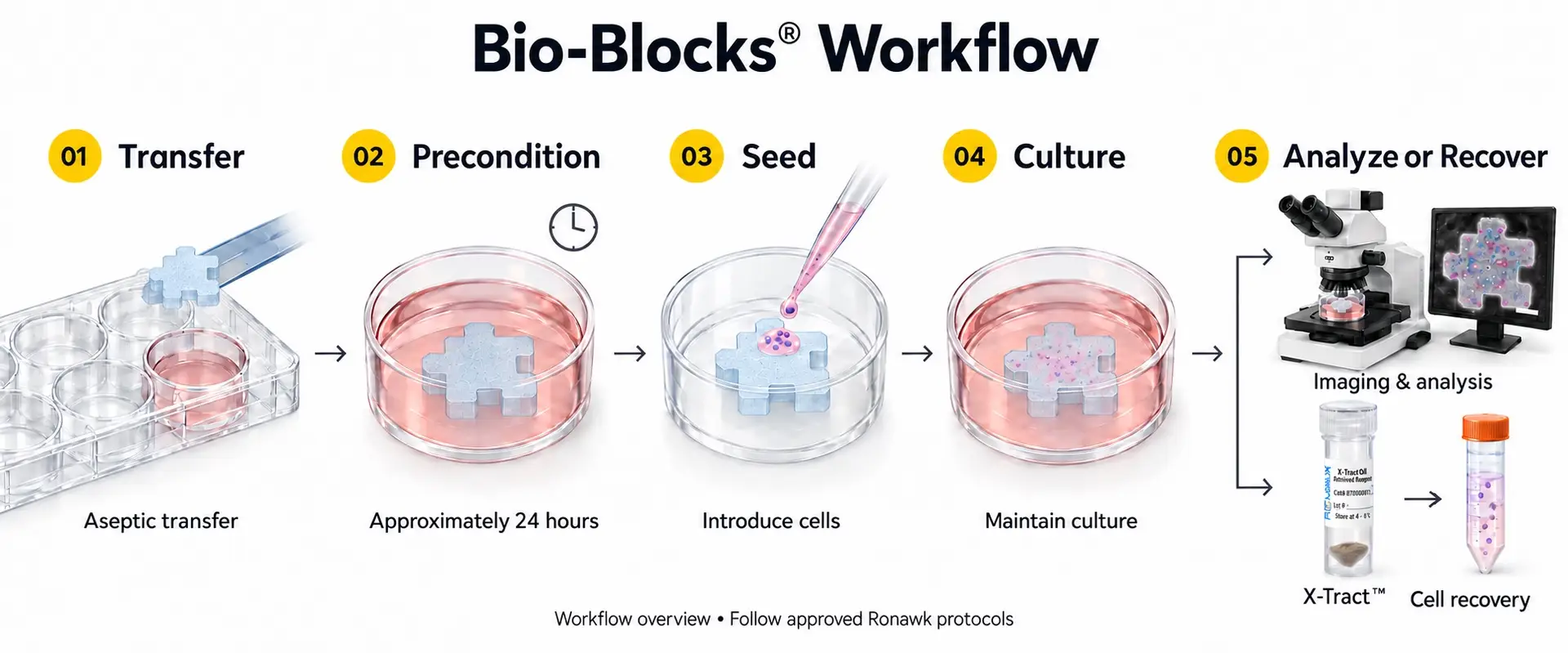
Bring your cell-culture experience to your next 3D experiment. Start with the cells and media appropriate for your study, then use Ronawk protocols to plan seeding, culture, imaging, recovery, and downstream analysis.
01
Aseptically transfer the Bio-Block into the desired plate or tube format.
02
Fully submerge the Bio-Block in the basal medium appropriate for your cells for approximately 24 hours before seeding.
03
Remove the preconditioning medium and introduce cells using the appropriate Ronawk seeding protocol or optimization framework.
04
Maintain the Bio-Block using the culture conditions appropriate for the selected cell population and experimental design.
05
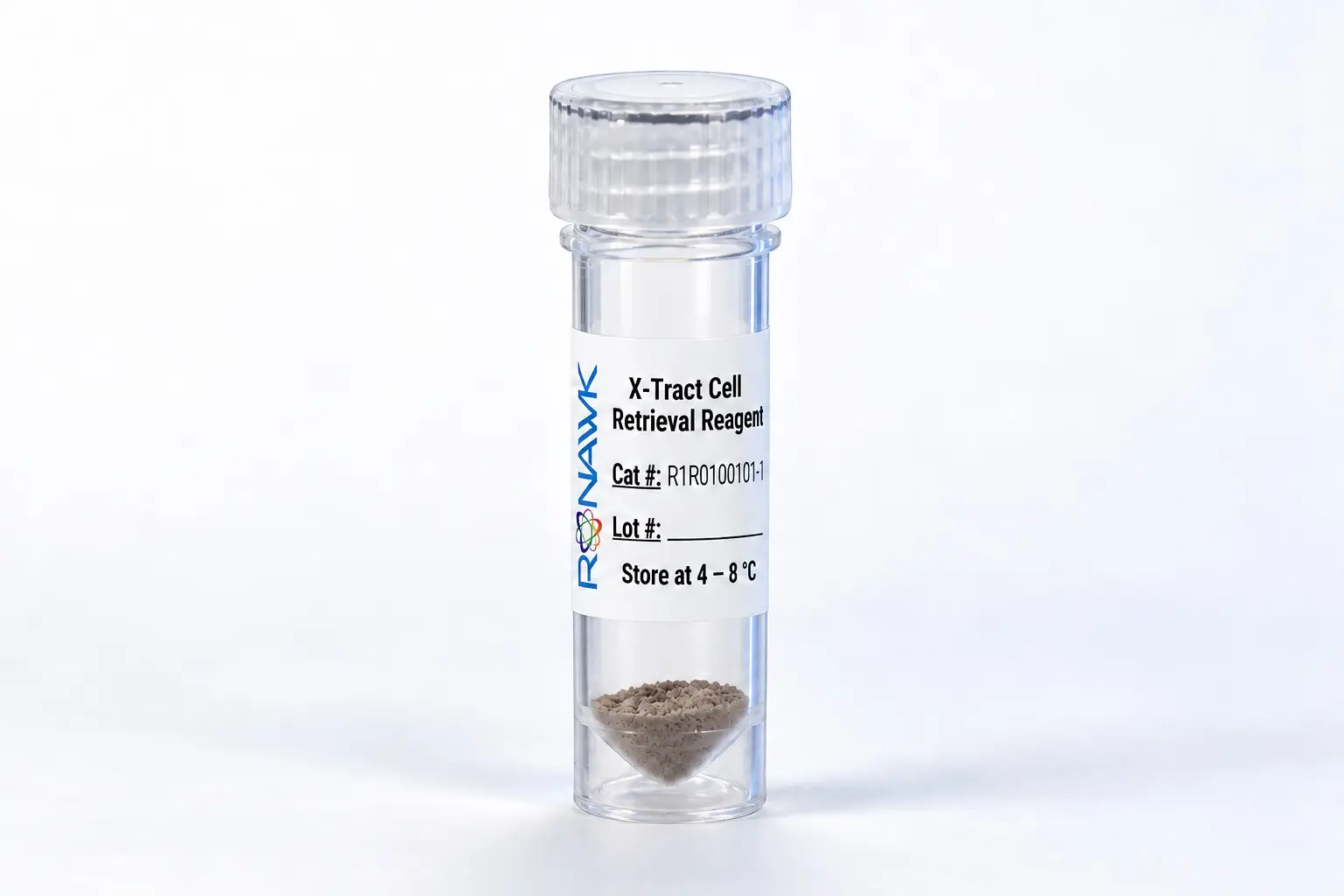
Image cells, collect conditioned media or cellular outputs, fix Bio-Blocks® for histology or immunolabeling, or dissolve X-Blocks™ with X-Tract™ for cell recovery.
TECHNICAL DOCUMENTATION
Plan your first Bio-Blocks experiment with protocols, imaging guidance, and safety information in hand. To discuss your cell model and workflow, contact Ronawk.
Safety, handling, storage, and disposal information for X-Block.
X-Block Safety Data Sheet (PDF)Safety, handling, storage, and disposal information for X-Tract.
X-Tract Safety Data Sheet (PDF)Preparation, cell seeding, and culture guidance for X-Block.
X-Block General Protocol (PDF)Block dissociation and cell recovery using X-Tract.
X-Tract Block Dissociation Protocol (PDF)Practical tips for bright-field and fluorescence imaging of cells on Bio-Blocks.
Bio-Blocks Imaging Guide (PDF)Materials and workflow for fixation of Bio-Blocks.
Paraformaldehyde Fixation Protocol (PDF)Immunolabeling workflow for Bio-Block samples.
Indirect Serial Double Label Immunocytochemistry (PDF)Explore how culture architecture influences cell behavior and secreted outputs. Original visual summaries of peer-reviewed studies show the results in adipose-derived mesenchymal stem/stromal cells.
The modular hydrogel approach allows an initially seeded block to connect with additional unseeded blocks. In Hodge et al. (Regenerative Medicine, 2023), ASCs populated the porous architecture and migrated across the interface into an attached hydrogel.
Reconstructed from data and figures in the corresponding cited paper; graphical estimates are approximate. Conceptual schematic of hydrogel attachment and cell migration; not to scale.
Hodge JG, Robinson JL, Mellott AJ. Novel hydrogel system eliminates subculturing and improves retention of nonsenescent mesenchymal stem cell populations. Regenerative Medicine. 2023;18(1):23–36. Published online October 12, 2022.
Read the peer-reviewed paper ↗Conceptual visualization produced from findings appearing in Hodge JG, Robinson JL, Mellott AJ. Novel hydrogel system eliminates subculturing and improves retention of nonsenescent mesenchymal stem cell populations. Regenerative Medicine. 2023;18(1):23–36. Published online October 12, 2022. doi:10.2217/rme-2022-0140. Source paper ↗
Senescence increased during extended 2D culture, while the study reported no significant change in 3D hydrogel cultures over six weeks. The reconstructed boxplots show the distributions at matched culture time points.
Reconstructed from data and figures in the corresponding cited paper; graphical estimates are approximate. Boxes, median lines and whiskers approximate the published plot; individual image-level points are omitted. 3D cultures were assessed at times corresponding to the 2D passages.
Hodge JG, Robinson JL, Mellott AJ. Novel hydrogel system eliminates subculturing and improves retention of nonsenescent mesenchymal stem cell populations. Regenerative Medicine. 2023;18(1):23–36.
Read the peer-reviewed paper ↗Visualization produced from data appearing in Hodge JG, Robinson JL, Mellott AJ. Novel hydrogel system eliminates subculturing and improves retention of nonsenescent mesenchymal stem cell populations. Regenerative Medicine. 2023;18(1):23–36. doi:10.2217/rme-2022-0140. Source paper ↗
Nanoparticle tracking analysis measured approximately 9.2 billion particles/mL in the isolated EV fraction from 2D ASC cultures and 65 billion particles/mL from 3D cultures under the conditions studied.
Reconstructed from data and figures in the corresponding cited paper; graphical estimates are approximate. Bars show reported particle concentrations; error bars show graphically estimated SD (n = 3).
Hodge JG, Decker HE, Robinson JL, Mellott AJ. Tissue-mimetic culture enhances mesenchymal stem cell secretome capacity to improve regenerative activity of keratinocytes and fibroblasts in vitro. Wound Repair and Regeneration. 2023.
Read the peer-reviewed paper ↗Visualization produced from data appearing in Hodge JG, Decker HE, Robinson JL, Mellott AJ. Tissue-mimetic culture enhances mesenchymal stem cell secretome capacity to improve regenerative activity of keratinocytes and fibroblasts in vitro. Wound Repair and Regeneration. 2023. doi:10.1111/wrr.13076. Source paper ↗ CC BY
Protein in the isolated extracellular-vesicle fraction increased between weeks 1 and 4 in Bio-Block ASC cultures, while it decreased in the 2D, spheroid, and Matrigel groups.
Reconstructed from data and figures in the corresponding cited paper; graphical estimates are approximate. Bars show means ± SEM from the source data; points show four recorded values per group. Gray: week 1; blue: week 4. p-values are Tukey-adjusted within-system comparisons.
Hodge J, Medina-Lopez A, Neal C, Decker H, Robinson J, Mellott AJ. Comparison of 3D culture systems on mesenchymal stem cell longevity, regenerative potential, and secretome production. Regenerative Medicine. 2025;20(10):455–474.
Read the peer-reviewed paper ↗Visualization produced from data appearing in Hodge J, Medina-Lopez A, Neal C, Decker H, Robinson J, Mellott AJ. Comparison of 3D culture systems on mesenchymal stem cell longevity, regenerative potential, and secretome production. Regenerative Medicine. 2025;20(10):455–474. doi:10.1080/17460751.2025.2572177. Source paper ↗
Explore how researchers have used Bio-Blocks in specific cell models and imaging workflows. Our Research & Progress overview connects these resources with the questions behind the work.
Nikon’s September 2024 application note examines confocal imaging of cellular organization and subcellular structures in Bio-Blocks.
Read the Nikon imaging application notePlan your experiment: Our fluorescence imaging guide for Bio-Blocks covers imaging depth, labeling, controls, and acquisition settings.
Download the imaging guide (PDF, 2 pages)A 2025 research paper compares culture systems for mesenchymal stem cell longevity, regenerative potential, and secretome production.
View the MSC culture comparison studyA 2026 study uses Bio-Blocks to investigate osteocyte-like cell responses to conditioned media from periodontal ligament cells.
Read the bone-cell research paperFindings apply to the models, materials, and conditions described in each source. Consult each study for the product configuration used; earlier studies may use T-Block or X-Block names.
Products are made to order. Please allow up to 15 business days after payment is received for your order to ship. Shipping transit time is additional. Orders are released for production and fulfillment only after Ronawk confirms payment and completes order and exemption review.
No. X-Blocks™ are supplied without cells. Researchers select the cells, media, and culture conditions appropriate for their experiment.
Bio-Blocks® have been used with primary cells, established cell lines, and tissue explants, with especially extensive experience in adherent-cell and mesenchymal stromal/stem cell (MSC) culture. Contact Ronawk to discuss your cell model and workflow.
Store at 4 °C in the supplied solution and original packaging. X-Blocks™ are aseptically manufactured.
Aseptically transfer the Bio-Block into the appropriate plate or tube, then fully submerge it in the basal medium appropriate for your cells for approximately 24 hours before seeding. Follow the applicable Ronawk protocol for detailed instructions.
Bio-Blocks® support workflows for imaging, conditioned-media collection, fixation, histology, and immunolabeling. X-Tract™ dissolves X-Blocks™ to aid in cell recovery; one unit dissolves one X-Block™. Select the workflow appropriate for your intended analysis.
Standard ordering quantities are 1, 6, or 12 X-Blocks™. Academic and nonprofit pricing is $299 per Bio-Block. Commercial organizations and customers needing more than 12 should contact Ronawk for pricing.
Bio-Blocks orders ship for a $50 flat rate per order within the contiguous United States, including combined BARS/Bio-Blocks orders. International customers and customers in Alaska or Hawaii should contact Ronawk to arrange ordering and shipping.
The standard X-Block™ has 300 µm microchannels. Other formulations or microchannel dimensions may be available by special request, subject to minimum-order requirements.
For Research Use Only. Not for human or diagnostic use.